Disorder
in
strongly
correlated
metals
Energy-Resolved Spatial Inhomogeneity of Disordered Mott Systems: Physica B 404, 3167 (2009)
Electronic Griffiths Phase of the d = 2 Mott Transition: Phys. Rev. Lett. 102, 206403 (2009)
Recommended and commented on in the Journal Club for Condensed Matter Physics, Jan/2012
Introduction
In recent years, fascinating new
evidence is emerging revealing that genuinely new phenomena (Miranda
and Dobrosavljevic, 2005) arise
in presence of disorder and
impurities. These phenomena often dominates the observable properties
in many systems, ranging from colossal magnetoresistance (CMR)
manganites and cuprates, to diluted magnetic semiconductors, Kondo
alloys, and even spin liquids.
Disorder
is also useful as a probe to reveal the underlying texture of several
system. A primary example of disorder as a probe comes from the
scanning tunneling microscopy (STM) in regular
metals, cuprates, and more recently heavy-fermion systems. Therefore,
understanding the combined effect of disorder and electron–electron
interactions is not only of immense experimental relevance, as it
also constitutes one of the most challenging problems in theoretical
condensed matter physics.
Electronic
Griffiths phase near Mott metal-insulator transitions
|
The metal-insulator transition (MIT) represents an important class of quantum criticality, one that often cannot be reduced to breaking any static symmetry. Conventional theories of the MIT in disordered systems, based on the diffusion mode picture, strongly resemble standard critical phenomena and thus do not easily allow for rare event physics or ‘‘infinite randomness fixed point (IRFP) behavior. There currently exists, however, a large body of experimental work, documenting disorder-induced non-Fermi-liquid behavior due to rare disorder configurations, even in systems far from any spin or charge ordering. In
this
study,
we
presented
the
first
detailed model calculation
investigating the effects of moderate disorder on the Mott metal
insulator in two dimensions. As the simplest description of the
effects of disorder on the Mott transition, we work within a
Brinkman-Rice scenario, where a Gutzwiller variational approximation
is applied to a disordered two dimensional Hubbard model (in its
standard notation, but with random on-site energies εi):
(i) for
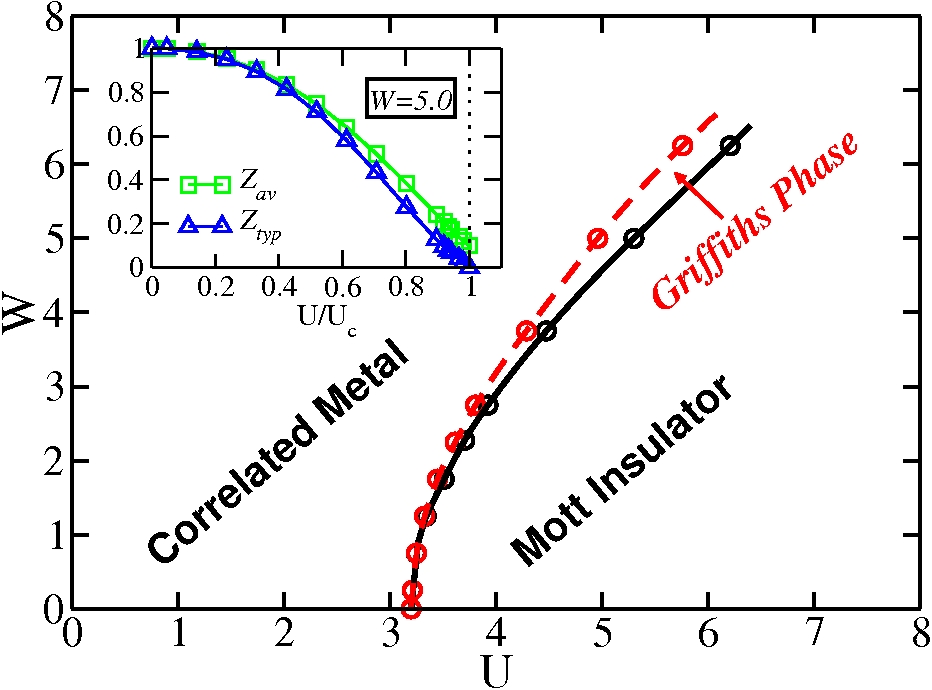
sufficiently weak disorder the transition retains the second
order Mott character, where electrons gradually turn into localized
magnetic moments;
(ii) disorder
induced spatial inhomogeneities (rare regions) give rise to
an intermediate electronic Griffiths phase that displays IRFP
character at the transition, even when we approach the Mott insulator
at weak disorder. This Griffiths phase is characterized by a singular
power-law distribtuion of the quasiparticle weight P(Z) ~ Zα-1 at low-Z, which imediately drives
a singular thermodynamic response: χ ~ Tα-1 and C/T ~ Tα-1;
(iii) the
renormalized disorder seen by quasiparticles is strongly screened
only at low energies, resulting in pronounced energy-resolved
inhomogeneity of local spectral functions.
|
|


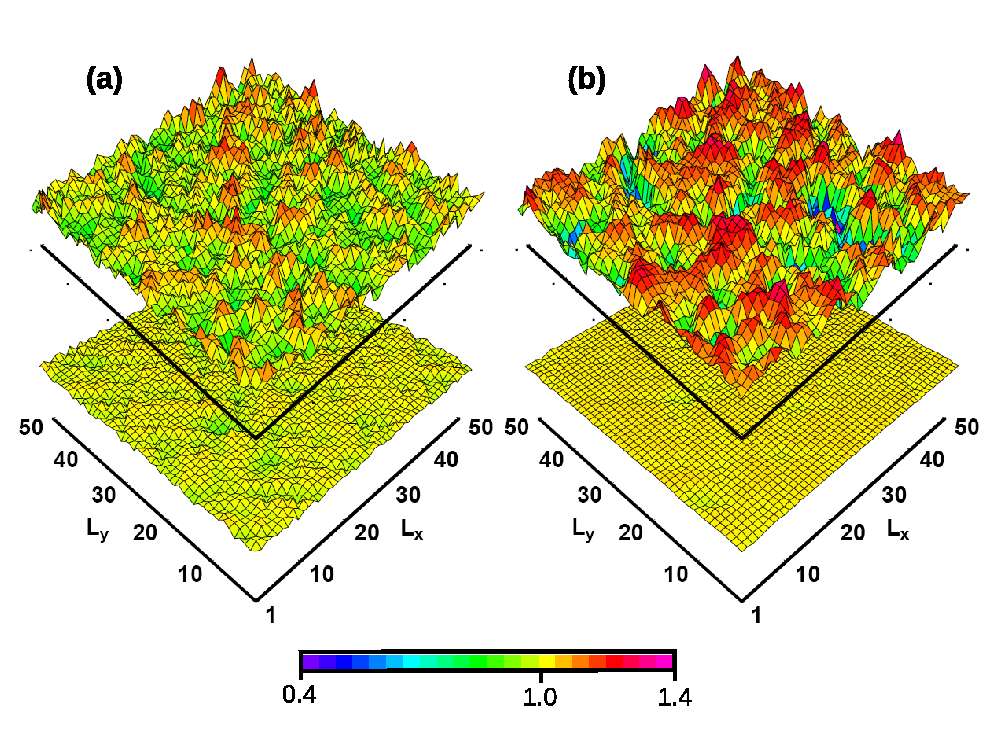 |
Fig. 3: Spatial distribution of the local density of states ρi normalized by its clean and non-interacting value for one given realization of disorder and two distinct values of interaction: U/UC=0.87 (a) and U/UC=0.96 (b). We consider two different energies E=0 (bottom) and E>0 (top) in both (a) and (b). Because of strong disorder screening, the renornmalized site energies |vi| « W close to UC. Thus, at the Fermi energy, the local density of states distribution becomes homogeneous as we approach the Mott transition. Conversely, if we move even slightly away from the Fermi energy, the fluctuations in Ztyp/Zi come into play and the system becomes in fact more inhomogeneous close to Mott metal-insulator transition |
Quantum Ripples in Strongly
Correlated Metals
|
We focus on single nonmagnetic impurity scattering in an otherwise uniform, strongly interacting, paramagnetic metal, where the analysis is most straightforward and transparent, but this general issue is of key relevance also for the diffusive regime. Once
more, a Gutzwiller variational approximation is applied to a
disordered two dimensional Hubbard model and we investigate how
well-known effects of the long-ranged Friedel oscillations are
affected by strong electronic correlations. Our mostly analytical
results demonstrate that:
(i) for
sufficiently weak correlations we recover the results of the
Hartree-Fock approximation, in which the effective scattering
potential generated by the impurity is set by the long-ranged Friedel
oscillations;
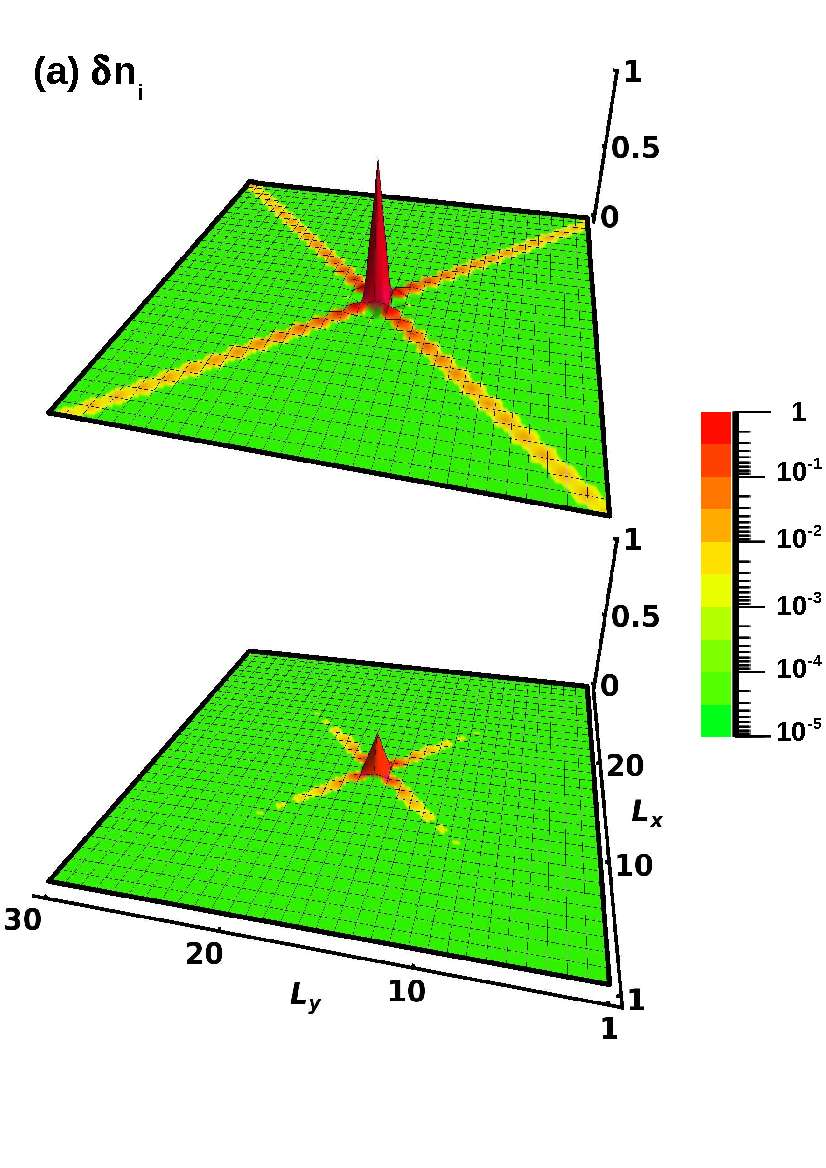
(ii) as we approach the Mott transition, however, these oscillations are strongly suppressed as the charge screening becomes more and more local, corresponding to a shorter ‘‘healing length’’; (iii) a combination of ‘‘healing’’ and inelastic scattering strongly suppresses the Friedel oscillation effects even for moderate correlations. |
|
 |
 |
|
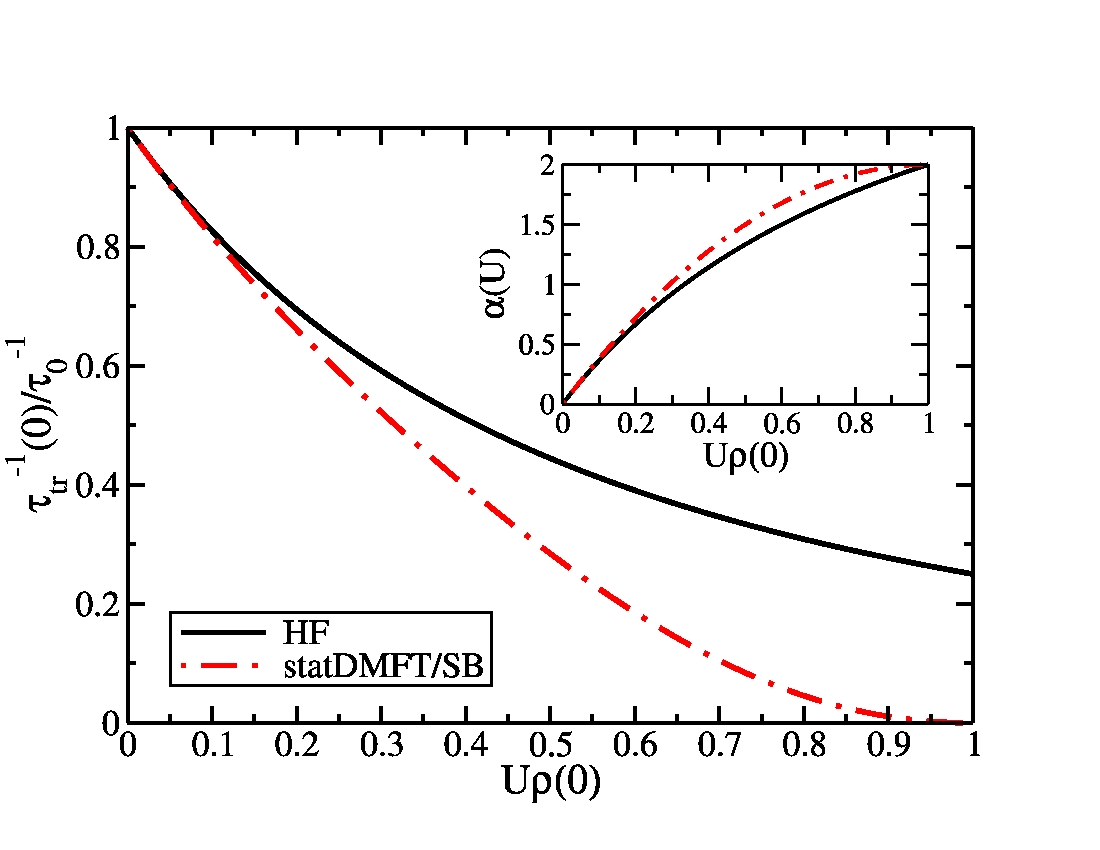
Fig. 5: Amplitude
of the the
energy dependent transport scattering rate, describing the
(elastic) scattering processes of quasiparticles off the screened
disorder
potential, as a function of the interaction strength U. We compare
the Hartree-Fock and Gutzwiller (slave-boson) results.
Inset: Leading elastic temperature correction to τtr
-1(T) as a function of the
interaction U. Here we
considered ρ(0)UC = 1.
|
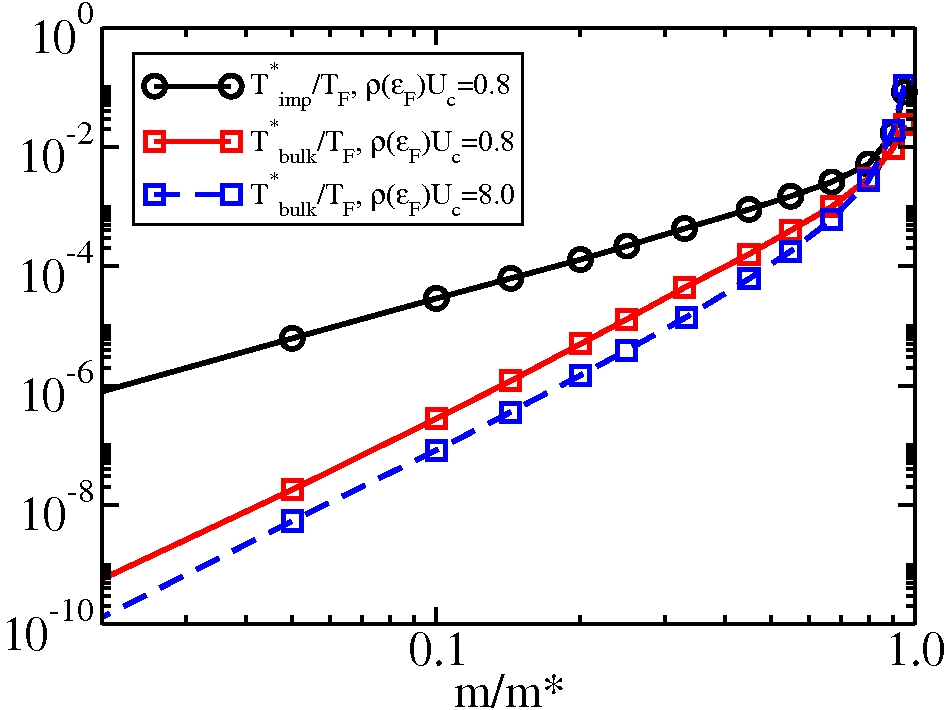
Fig. 6: Limiting temperatures to the linear in T regime of the resistivity of a electron liquid in d = 2 on a log-log scale, calculated under two different assumptions. T*bulk is the dominating cutoff above which the linear behavior is lost. Thus, the linear in T non-Fermi-liquid region is limited to very low temperatures. Ultimately, as this linear in T regime is also bounded from below by a crossover to the diffusive regime, the ballistic T interval in which these elastic corrections dominate may not be present at all. |