Quantum Critical Transport Near the
Mott
Transition
Published in Phys. Rev. Lett. 107, 026401 (2011)
Published in Phys. Rev. Lett. 107, 026401 (2011)
INTRODUCTION
the Mott point?"
|
Scaling
ideas
and QFT are often associated with the phenomenon of
disordered-driven Anderson localization of
non interacting electrons.
However, a considerable number of experiments
provide compelling evidence that strong
correlation effects may be the dominant mechanism of the
metal-insulator transition (MIT)-- some form of Mott localization.
Should one then expect
similar or very different
transport phenomenology in the Mott picture?
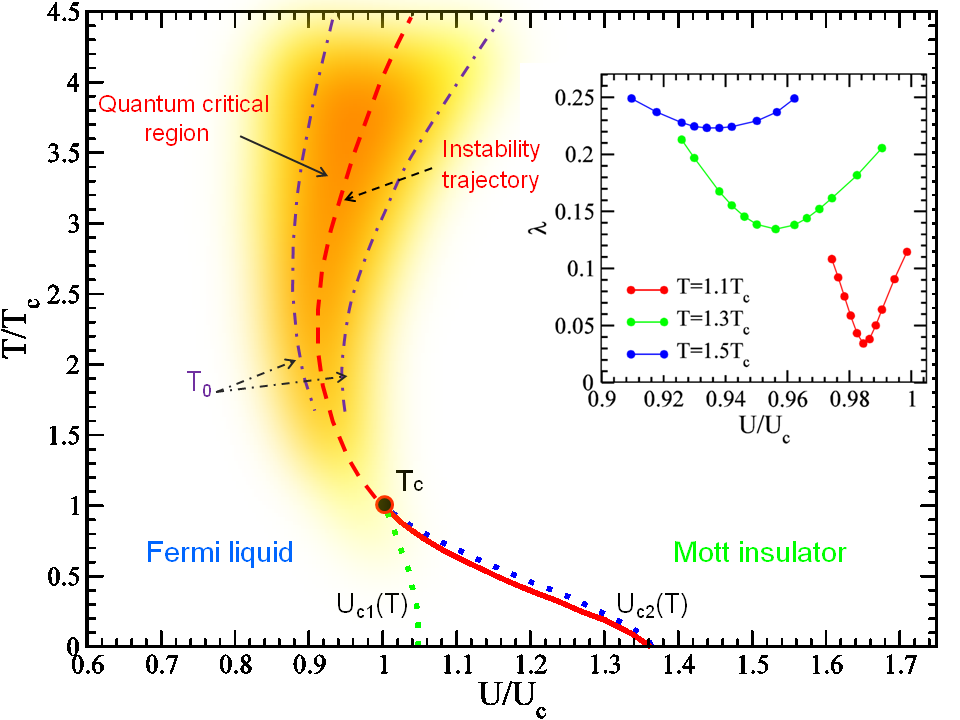
Many systems close to the MIT often display surprisingly similar transport features in the high temperature regime. Here, the family of resistivity curves typically assumes a characteristic ``fan-shaped'' form (Fig. 1-a), reflecting a gradual crossover: at high T resistivity depends only weakly on the control parameter, while at low T system rapidly converges towards metal or insulator. Since temperature acts as a natural cutoff scale for the metal-insulator transition, such behavior is precisely what one expects for quantum criticality . In some cases the entire family of curves displays beautiful scaling behavior, with a remarkable ``mirror symmetry'' of the relevant scaling functions. |
|
OUR APPROACH
"Under
which
microscopic
conditions should one expect such
scaling phenomenology? What is the corresponding
driving force for the transitions?"
MAIN
RESULTS
driving force for the transitions?"
| Despite
recent
progress,
such basic physics questions remain the subject of
much ongoing controversy and debate. Moreover, they are
not easy to address to because conventional Fermi liquid concepts
simply
cannot be utilized in the relevant high temperature incoherent DMFT-- the only
theoretical method that is most reliable precisely at high
temperatures. To address the question of possible QC scaling phenomena in systems where the Mott localization is the driving force of MIT, we focus on half-filled fully-frustrated Hubbard model, and solve it within DMFT framework. |
|
"Is
it possible to
reveal
any features of QPT when focusing
on the model where MIT is driven purely by electron-
electron interactions?"
This
behavior, which is
surprisingly similar to
some experimental findings, indicates that Mott quantum
criticality may be acting as the fundamental mechanism behind the unusual transport phenomena in
electron interactions?"
| To
answer this
question,
we performed a systematic
study
of incoherent
transport in the high temperature crossover region of the half-filled
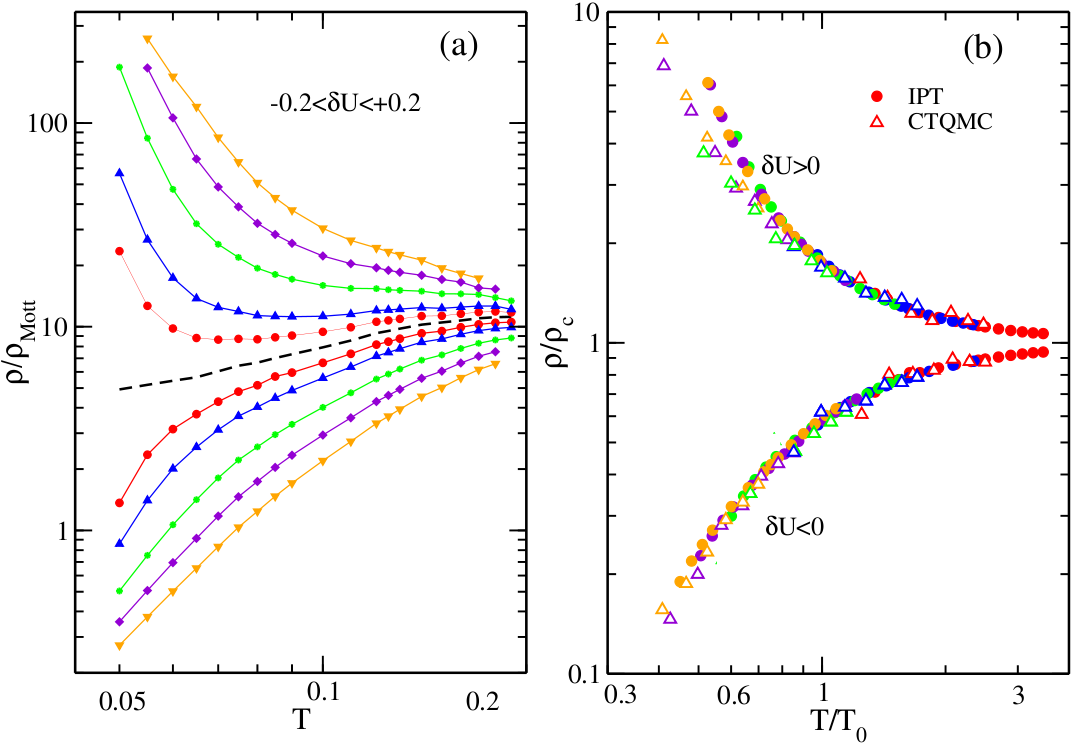
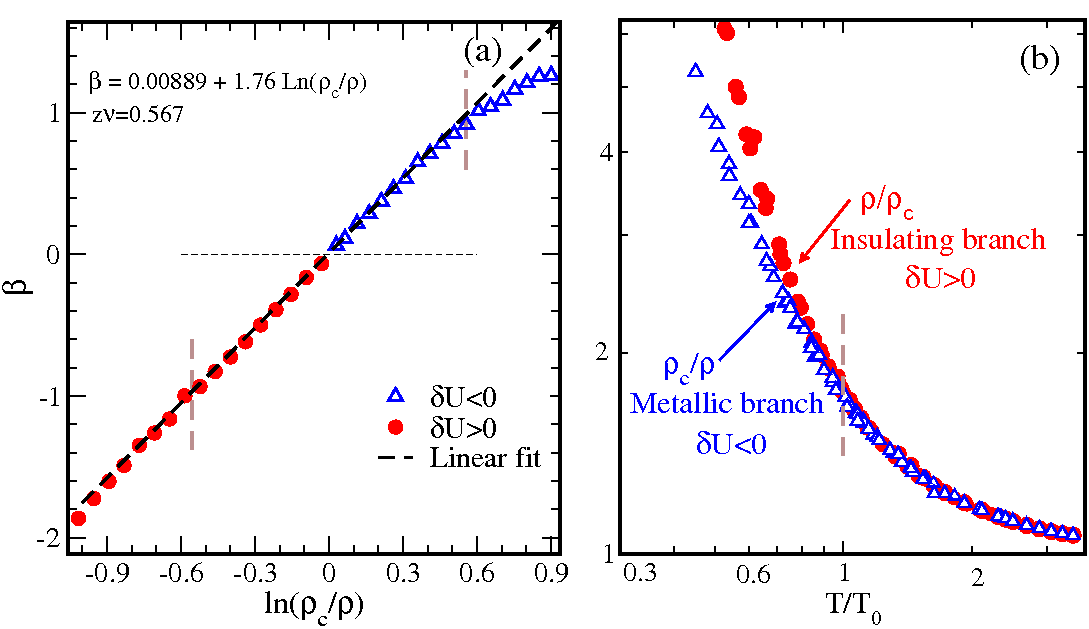
one-band Hubbard model. Main results are shown in Fig. 2 and Fig. 3. We find that the family of resistivity curves (Fig. 2-a) displays characteristic quantum critical scaling (Fig. 2-b) of the form ρ( T , δ U ) = ρc ( T ) f (T/ T0 (δ U)), with T0 (δ U)~|δU|zν The corresponding beta-function ~ln(ρc/ρ ) (Fig. 3-a) displays a ``strong coupling'' form reflecting the peculiar mirror symmetry of the scaling curves (Fig. 3-b). |
|
criticality may be acting as the fundamental mechanism behind the unusual transport phenomena in
many systems near the
metal-insulator transition.
More details on this project can be found in our recent PRL paper.
More details on this project can be found in our recent PRL paper.