Fingerprints of Intrinsic Phase
Separation:
Magnetically-doped 2D Electron Gas
Published in Phys. Rev. Lett. 106, 186402 (2011)
Magnetically-doped 2D Electron Gas
Published in Phys. Rev. Lett. 106, 186402 (2011)
INTRODUCTION
"Direct or Indirect routes towards the metal-insulator transition: existence of an intermediate phase near the MIT"
|
In addition to Anderson and
Mott localization, intrinsic
phase
separation (IPS) has
long
been
advocated
as
the
third
fundamental
mechanism
controlling
the doping-driven metal-insulator transitions. In electronic system,
where charge neutrality precludes global phase separation, it may lead
to various inhomogeneous states and dramatically affect transport.
The relevance of such a
nano-scale PS in its many
proposed forms (bubbles, stripes, checkerboard patterns), has been
advocated for the bad metal regimes of cuprates,
manganites
, and even low density 2D
electron
gases.
Still, in most of these cases, no
clear and conclusive evidence has been presented that intrinsic (not disorder driven) phase
separation
-
as
driving
force
for the
metal-insulator crossover -
dominates the bad metal regime.
|
|
MODEL
"Example
of
a
physical
system
where
IPS can be precisely and clearly
identified"
|
To make progress in
understanding the relevance of IPS, we focus on the
model where the microscopic origin of IPS is understood, and transport
signatures can be identified that makes it possible to distinguish IPS
from spurious disorder effects.
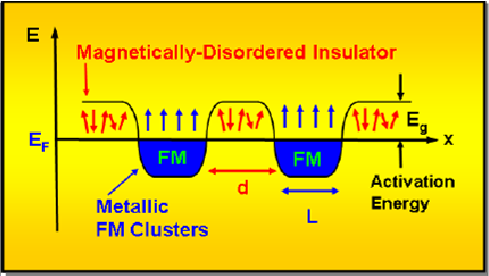
Recent experimental work on Mn-doped 2DEG seem to be an ideal setting for such an IPS. Here sufficient doping induces FM correlations between the Mn-spins, which can prevail over the usual Mn-Mn AFM superexchange that exists even in absence of carriers. Corresponding minimal Hamiltonian describing such system is of the form:  At very low doping levels the situation is rather subtle. Here the average kinetic energy gain obtained by FM ordering is not sufficient to balance the energy cost of AFM superexchange that opposes it. A compromise is reached through phase separation (Fig. 1) with FM carrier-rich regions being formed inside carrier-poor PM (AFM) system. |
|
MAIN RESULTS
"How to recognize IPS: specific and concrete transport features of IPS that makes it diffrent from extrinsic (disorder) PS"
| To
establish quantitatively IPS we first constructed phase
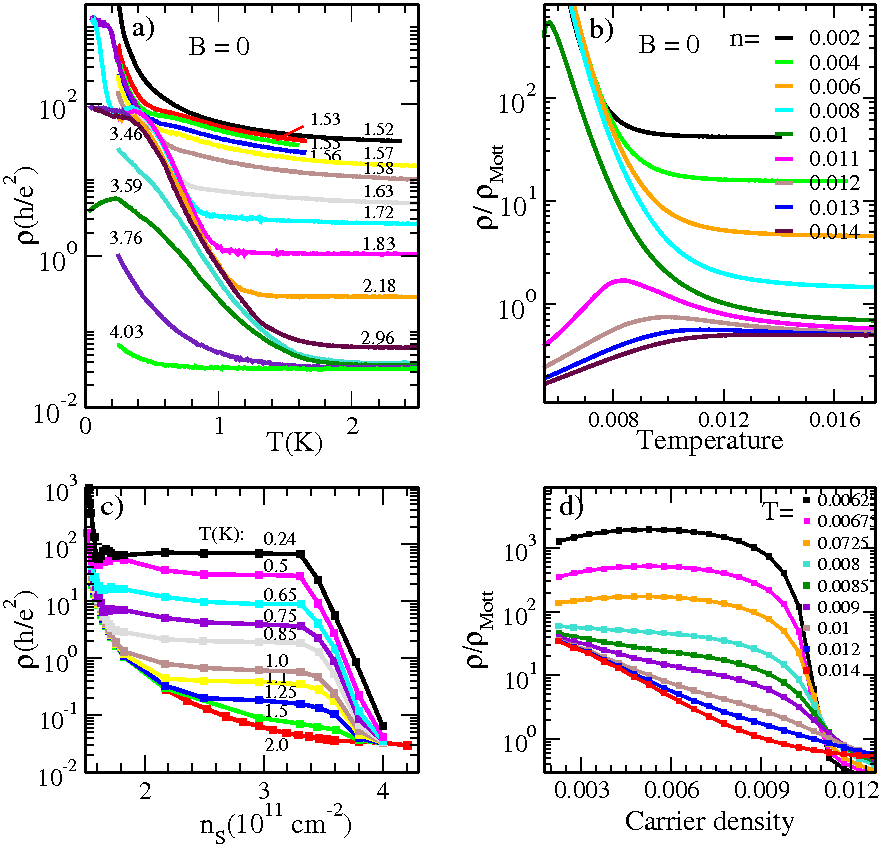
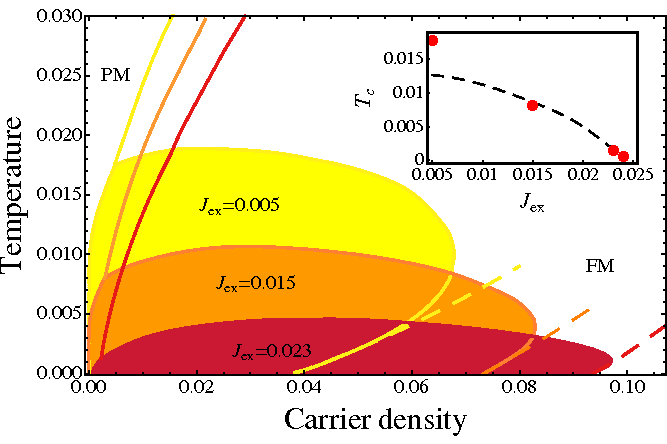
diagram shown in Fig. 2. Here for carrier densities below critical value nc=f(Jex) system phase separates (shaded area) with carries being trapped inside FM clusters. To study an effect of such IPS on transport, we calculated resistivity in such coexistence region. As a results, we find an anomalous behavior in transport in an intermediate regime around the transition: resistivity curves display strong temperature dependence (Fig. 3-a)-b)), but are very weak function of carrier densities n (Fig. 3-c)-d)). This behavior also reflects the fact that within this region activation energy as well as the size of the PS regions is density independent. Such transport behavior with a sharp upturn in resistivity in the low temperature regime, and its weak n-dependence are direct consequences of IPS. Our theoretical predictions (right panel of Fig. 3) are in striking agreement with recent experiments (left panel) on Mn-doped CdTe quantum wells, a system where we identify the microscopic origin for intrinsic phase separation. |
|