There is no better way to understand physical
processes than to see them happening in front of one's own
eyes. This is possible to do using Java applets that we have
created, which anyone can directly use.
Note: Most modern browsers no
longer support JAVA. These applets, however, can still be
accessed using Chrome, if one adds to it the CheerpJ web
browser extension. This enables old JAVA applets to run
within Chrome. It can be directly downloaded from the Web.
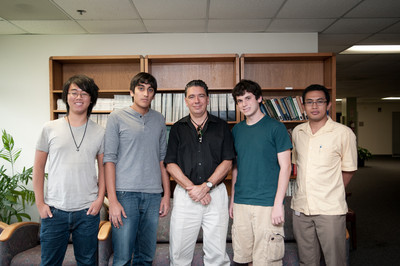 (left
to right) Michael Chiang, Nauman Javed, Prof. Dobrosavljevic,
Eric Pelz, Yohanes Pramudya
This facility was originally developed, almost single-handedly, by high school summer intern Eric Pelz, who spent six weeks over Summer 2010 at the NHMFL, as part of Florida's Young Scholars Program. Eric created these Java applets, starting from Monte-Carlo routines developed by graduate student Yohanes Pramudya, under the guidance of Professors Dobrosavljevic and Manousakis. This work continued until May 2011 while Eric completed his senior year of high school. Eric returned to the NHMFL in Summer 2011 and is now an undergraduate at Caltech.
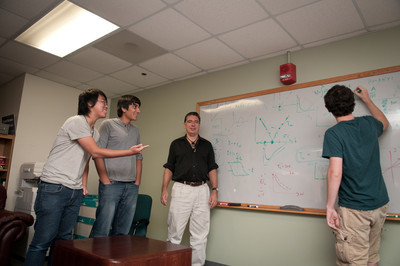 Eric Pelz (right)
instructs Michael and Nauman (left) under the watch of Prof.
Dobrosavljevic.
In June 2011, our group welcomed two new high school interns, Nauman Javed and Michael Chiang, as part of Florida's Young Scholars Program. Nauman and Michael, under the mentorship of Eric, created new Java simulations, starting from Fortran routines by Professor Rozenberg that modeled resistive switching in transition metal oxides. Currently, Nauman is working on a second resistive switching simulation, under the guidance of Eric and Professors Dobrosavljevic, Zimanyi and Rozenberg. This simulation implements a differing theory for resistive switching based on work published by HP labs. This work, which started in June 2010, continues to this day, although Nauman is completing his senior year of high school in Sanford, FL.
Java simulations
Below are simulations created by this group. Please click "show more..." for a brief introduction to each simulation, or click on its name to open it.
- Resistive Switching in Memristor Devices (Rozenberg)
- Coulomb-limited Phase Separation (CLPS)
- Nuclear Pasta Phase
- Long-Range Interactions on a Partially-Filled Lattice
- Long-Range Interactions on a Partially-Filled Lattice with a Time-Dependent Impurity
- Long-Range Interactions on a Half-Filled Lattice
- Short-Range Interactions
Created by Nauman Javed with the help of Eric Pelz and Professors Rozenberg and Dobrosavljevic at the NHMFL at the FSU.
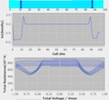
Simulation of the resistive switching model introduced by Rozenberg, Sánchez, Weht, Acha, Gomez-Marlasca, and Levy. The model describes the conduction along a 1D resistive network path, having two memristive interfaces at either end. The upper panel shows the density of oxygen vacancies along the 1D path, the lower panel shows the two-terminal resistance across the system. If the resitivity parameters A at either end are large, the R vs V curve shows the phenomenon of "table-with-legs" that results from the two memristive interfaces. If the parameter A is large in only one interface (single memristor), the R vs V curve is a simple high-R to low-R loop.
The simulations employ tunable parameters and real-time plots so the physical processes can easily be further investigated.
Created by Eric Pelz with the help of Yohanes Pramudya and Professors Dobrosavljevic, Manousakis and Piekarewicz at the NHMFL at the FSU.
This Java applet presents a simulation of a classical liquid with competing interactions: long-range Coulomb repulsion V(R)=1/R and a finite-range uniform attaction of strength V and range R_o. The simulation is implemented on a partially-filled square lattice, using Monte Carlo methods. By default, when the simulation starts, the system shows a lattice at 5% filling, but the filling can be modified, if desired.
The phenomenon of Coulomb limited phase separation is found in many lightly doped insulators. It has come to focus with the discovery of high-temperature superconductors, as first noted in the seminal work of Gor'kov and Sokol.
We use Java applets to visualize classical Monte Carlo simulations, using the Metropolis algorithm with Boltzmann statistics. Electric charge and lattice spacing are taken to be one to make the temperature T dimensionless. The periodic boundary condition was used to reduce finite-size effect and the interaction energy was calculated by Ewald Summation. We can tune Coulomb interactions, add frozen impurities, an external electric field, and particle tracking.
Created by Eric Pelz with the help of Yohanes Pramudya and Professors Dobrosavljevic, Manousakis and Piekarewicz at the NHMFL at the FSU.
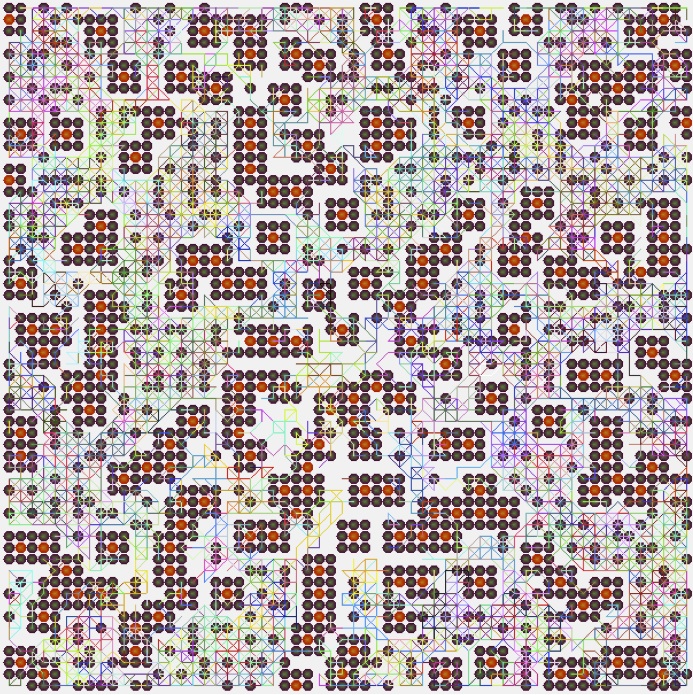
This Java applet presents a simulation of the described "pasta phase" with competing interactions: short-range proton-proton repulsion of strength P-P, short-range neutron-neutron repulsion of strength N-N, short-range proton-neutron attraction of strength P-N, and long-range proton-proton Coulomb interactions V(R)=1/R of strength V. The short-range interactions have range R_o. The simulation is implemented on a partially-filled square lattice using Monte Carlo methods. Protons are displayed as red particles and neutrons as black particles. By default, when the simulation starts, the system shows a lattice at ~17% filling with a 10% proton-neutron ratio, but the filling and ratio can be modified, if desired.
Created by Eric Pelz with the help of Yohanes Pramudya and Professors Dobrosavljevic and Manousakis at the NHMFL at the FSU.
Simulation of a classical liquid with long-range Coulomb interactions V(R)=1/R on a partially-filled square lattice, using Monte Carlo methods. By default, the system shows a lattice at 5% filling.
We use Java applets to visualize classical Monte Carlo simulations, using the Metropolis algorithm with Boltzmann statistics. Electric charge and lattice spacing are taken to be one to make the temperature T dimensionless. The periodic boundary condition was used to reduce finite-size effect and the interaction energy was calculated by Ewald Summation. We can add frozen impurities, an external electric field, and particle tracking.
Created by Eric Pelz with the help of Yohanes Pramudya and Professors Dobrosavljevic and Manousakis at the NHMFL at the FSU.
Simulation of a classical liquid with long-range Coulomb interactions V(R)=1/R on a partially-filled square lattice, using Monte Carlo methods.
Features a time dependent impurity in the system, which contains a charge of Q=Q0*cos(ω*t), where t is the number of iterations performed and Q0 and ω are tunable constants. Once added, the screening charge (Qsc) and the charge (Q) are plotted on a chart as time develops (Q vs -Qsc).
We use Java applets to visualize classical Monte Carlo simulations, using the Metropolis algorithm with Boltzmann statistics. Electric charge and lattice spacing are taken to be one to make the temperature T dimensionless. The periodic boundary condition was used to reduce finite-size effect and the interaction energy was calculated by Ewald Summation. We can add a time dependent impurity, frozen impurities, an external electric field, and particle tracking.
Created by Eric Pelz with the help of Yohanes Pramudya and Professors Dobrosavljevic and Manousakis at the NHMFL at the FSU.
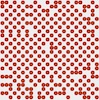
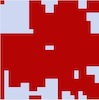
Simulation of a classical liquid with long-range Coulomb interactions V(R)=1/R on a half-filled square lattice, using Monte Carlo methods. At low temperatures the liquid freezes into a "checkerboard pattern" (e.g. Wigner crystal). As the temperature is raised above Tc ~ 0.1, the crystal melts. The melting temperature is dramatically reduced by fluctuation effects induced by strong frustration characterizing the long-range Coulomb interaction.
We use Java applets to visualize classical Monte Carlo simulations, using the Metropolis algorithm with Boltzmann statistics. Electric charge and lattice spacing are taken to be one to make the temperature T dimensionless. The periodic boundary condition was used to reduce finite-size effect and the interaction energy was calculated by Ewald Summation. We can add frozen impurities, an external electric field, and particle tracking.
Created by Eric Pelz with the help of Yohanes Pramudya and Professors Dobrosavljevic and Manousakis at the NHMFL at the FSU.
Simulation of a classical liquid with repulsive nearest neighbor interactions V=1 on a square lattice using Monte Carlo methods. At low temperatures the liquid freezes into a "checkerboard pattern" (e.g. Wigner crystal), since the lattice is chosen to be half-filled. As the temperature is raised above Tc ~ 2, the crystal melts.
We use Java applets to visualize classical Monte Carlo simulations, using the Metropolis algorithm with Boltzmann statistics. Electric charge and lattice spacing are taken to be one to make the temperature T dimensionless. The periodic boundary condition was used to reduce finite-size effect and the interaction energy was calculated by Ewald Summation. We can add frozen impurities and particle tracking.