INTRODUCTION
" The effect of Coulomb interaction "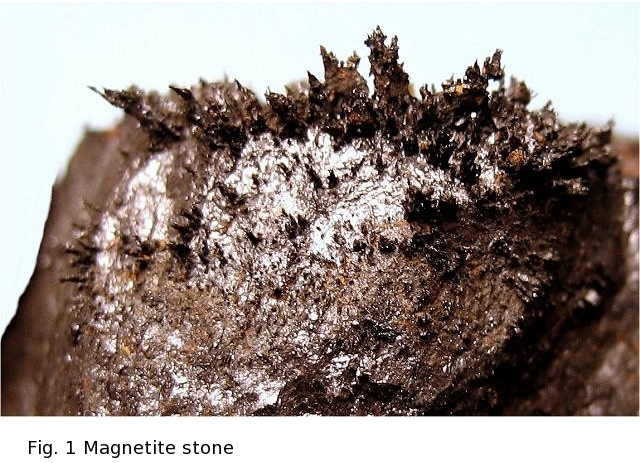
One of the simplest mechanisms for interaction-driven localization is Wigner crystallization. In a system of interacting electrons, when the Coulomb interaction energy between electrons sufficiently dominates the kinetic energy or thermal fluctuations, electrons crystallize into a solid (Wigner Crystal). The picture of Wigner crystallization can be realized in many systems, ranging from the ultra low density 2D electron or hole liquid [Tsui] in semiconductor devices, to magnetite Fe3O4 (Fig. 1) close to the Verwey transition [Khomskii, Mott].
Wigner crystal (WC) is believed to be extremely fragile to both quantum and thermal fluctuations, which reflects the strong frustration introduced by the Coulomb forces. Indeed, the melting temperature Tc of a classical Wigner crystal is as low as 1% (continuum models) to 10% (lattice models) of the Coulomb energy Ec (nearest-neighbour repulsion). Such behavior is, in fact, a general property of the entire family of models with long-range interactions of the form V (r) ∼ 1/rα. Then a broad temperature regime exists Tc<T<<Ec where one finds a “nearly frozen” liquid featuring a “soft” Coulomb pseudogap, which tends to gradually fill-up as T increases (see Fig.2). Interesting is the fact that transport here is no longer of an activated form, but shows a much weaker (still insulating-like) behaviour.
Our main focus in this project is to study the behaviour of Wigner crystal (modeled by the classical lattice gas models with long range interactions) just above the melting temperature at T > Tc where pseudogap can be identified. At this regime an unusual transport behaviour of the system (as seen experimentally) is governed by a process of melted Wigner crystal. To address these issues, we use both numerical - Monte Carlo simulations, and analytical - extended dynamical mean-field theory (EDMFT) which show excellent agreement.
OUR MODEL
" Coulomb interaction in half-filled lattice "
We focus on the simplest possible model that can be studied in detail. In particular, we consider Hamiltonian of the form

where spinless electrons interact via repulsive interaction of the form

Here, ni is the occupation number of the
lattice site i (ni=0 if site is empty,
and
ni=1 if electron is on that site). We first examine
half-filled lattice model with
<n>=1/2, where the system can be
viewed as AF Ising model with the spin si=2( ni-1/2)
METHOD
" Exact and Analytical solution of the model "
- Monte Carlo Study
We use classical Monte Carlo simulations, using Metropolis algorithm with Boltzmann statistics. Electric charge, lattice spacing, and dielectric constant are taken to be one to make the temperature T dimensionless. The system is a hyper cubic half -filled lattice with a fixed number of particles. The periodic boundary condition was used to reduce finite-size effect and the interaction energy was calculated by Ewald Summation
Some of our simulations you can find on other sub-pages of this site. Enjoy!
-
Extended Dynamical Mean Field Theory
In addition to the numerical simulations,
we have also developed an analytical approach to this model - Extended
Dynamical
Mean
Field
Theory
(EDMFT). This approach, which has
been developed by a former postdoc (Sergey Pankov [PRL 94,046402,2005])
will be further tested in the future by comparing with MC simulation in
a broad range of parameters, and
different models. So far our results show remarkable agreement of both
method. Moreover, we established that conventional approaches
such as spherical model (SM) and RPA cannot describe pseudogap
formation (see figure 2), which is the main focus of our work.
RESULTS
" Transport properties based on how easy electron to hop from site to site "
-
Pseudogap State
In our study we mainly focused on the
pseudogap regime at T>Tc. In order to calculate
transport properties, we need to find the single
particle
density
of
state (DOS) which is just a distribution function of
electrostatic potentials φ (average over simulation time) for every
point on the lattice. It gives the information how hard/easy
electron can jump/hop from site to site in the lattice.

An example of Monte Carlo and EDMFT results for the Density of States are shown in Fig. 2.
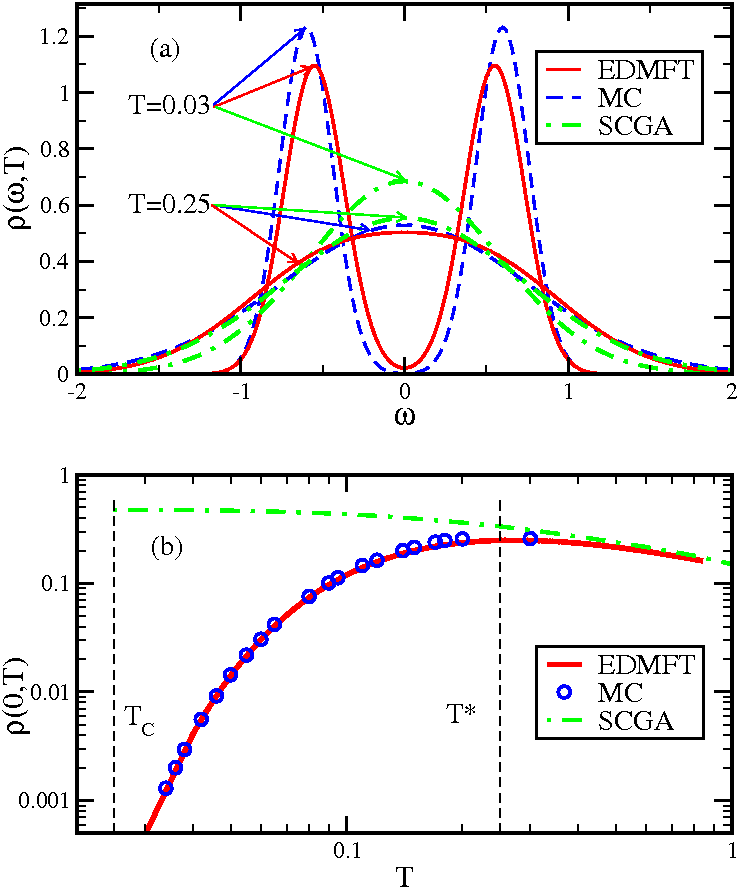
Figure 2: Single particle density of states (DOS) for α=0.3 at two different temperatures: low temperature (solid lines) T = 0.03 < T* and T=0.3 >T* (dashed lines). Monte Carlo results (dotted blue line), EDMFT (red line), Spherical Model (green line)). The Spherical Model cannot capture the pseudogap formation, although it is accurate at high temperatures T >> T*, outside the pseudogap phase.
At low temperatures T<<Tc electrons form a checkerboard pattern and DOS consists of two delta functions representing occupied and unoccupied states. On the other hand, at very high temperatures T>>Tc, the DOS is a Gaussian function. At such high temperatures since there are no correlations between electrons (which are arranged randomly), the potential at any site becomes the sum of many independent variables. Based on the central limit theorem, the distribution function of independent random variables is Gaussian. This explains the Gaussian form of the DOS at high T. Meanwhile, in the intermediate temperature range still above Tc, two Gaussian functions are observed with pseudogap state (DOS is not zero at w=0) being gradually filled with increase of T and disappearing at T>T*.
-
EDMFT and Monte Carlo Phase Diagram
Here we present the temperature – interaction range phase diagram of our model based on our MC and EDMFT results.
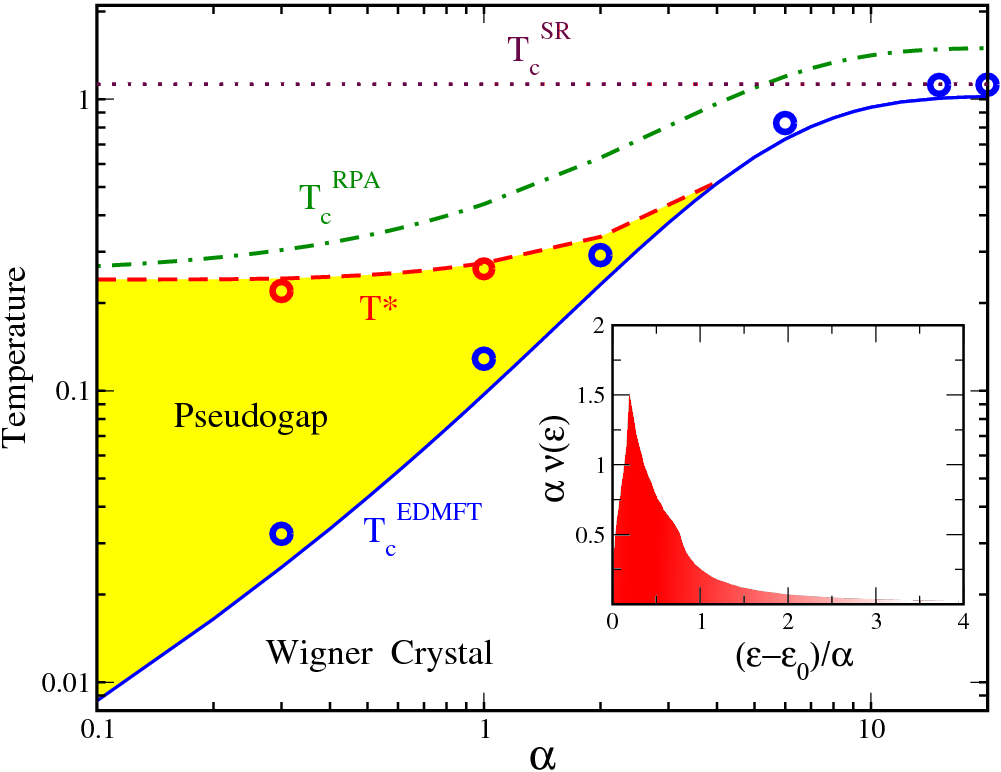
Figure
3:
Temperature -interaction range phase diagram in 3D system. Tc
is the melting temperature of Wigner Crystal (solid red line is EDMFT
result, and blue dots are MC results). T* (dashed orange line) is the
limit of the pseudogap phase. This pseudogap phase (shaded yellow
region) determined from EDMFT at temperature Tc<T< T* is wider as
α smaller.
The inset shows that EDMFT (red line) results agree with Monte Carlo
(MC) result (blue dots) over a wide range of interaction range exponent
α. Dash blue line is the of short range (α->infinity) interaction
limit of the melting temperature for MC. The green dash-dot line is
Random Phase Approximation (RPA) result that has non zero melting
temperature at α = 0 and Tc is higher than the pseudogap temperature
T*. Note that RPA result doesn't have pseudogap phase.(The unit of
temperature is the nearest
neighbor interaction energy (e2/a)).
The main features of Fig. 3 are:
- We can identify three main regions of the phase diagram: 1) At low T, below melting temperature Tc, the system is ordered in a Wigner Crystal, 2) At high temperatures T>T*, the Wigner crystal is melted and we have an electron fluid, 3) In between, at Tc<T<T* (yellow shaded area,) we identify a pseudogap regime.
- At small α (very long range interactions), the melting temperature Tc (blue dots are MC results and solid red line is EDMFT result) is of the form Tc ~ 0.1 α. This quasi-linear dependence extends over a wide range of α. The Coulomb potential (α=1 - red dot) lays deep inside the regime controlled by α=0 point, where EDMFT becomes very accurate. This perhaps explains the success of EDMFT theory in Coulomb system by Pankov and Dobrosavljevic [PRL 94,046402,2005]
- Within a wide range of the interaction range exponent α, the EDMFT and MC results show remarkable agreement. While conventional approaches such as spherical model (SM) and RPA (dashed green line in Fig. 2 ) cannot describe pseudogap formation.